Custom AI Operating Systems for Modern Businesses
Your Business Should Run on a System Built for Your Business.
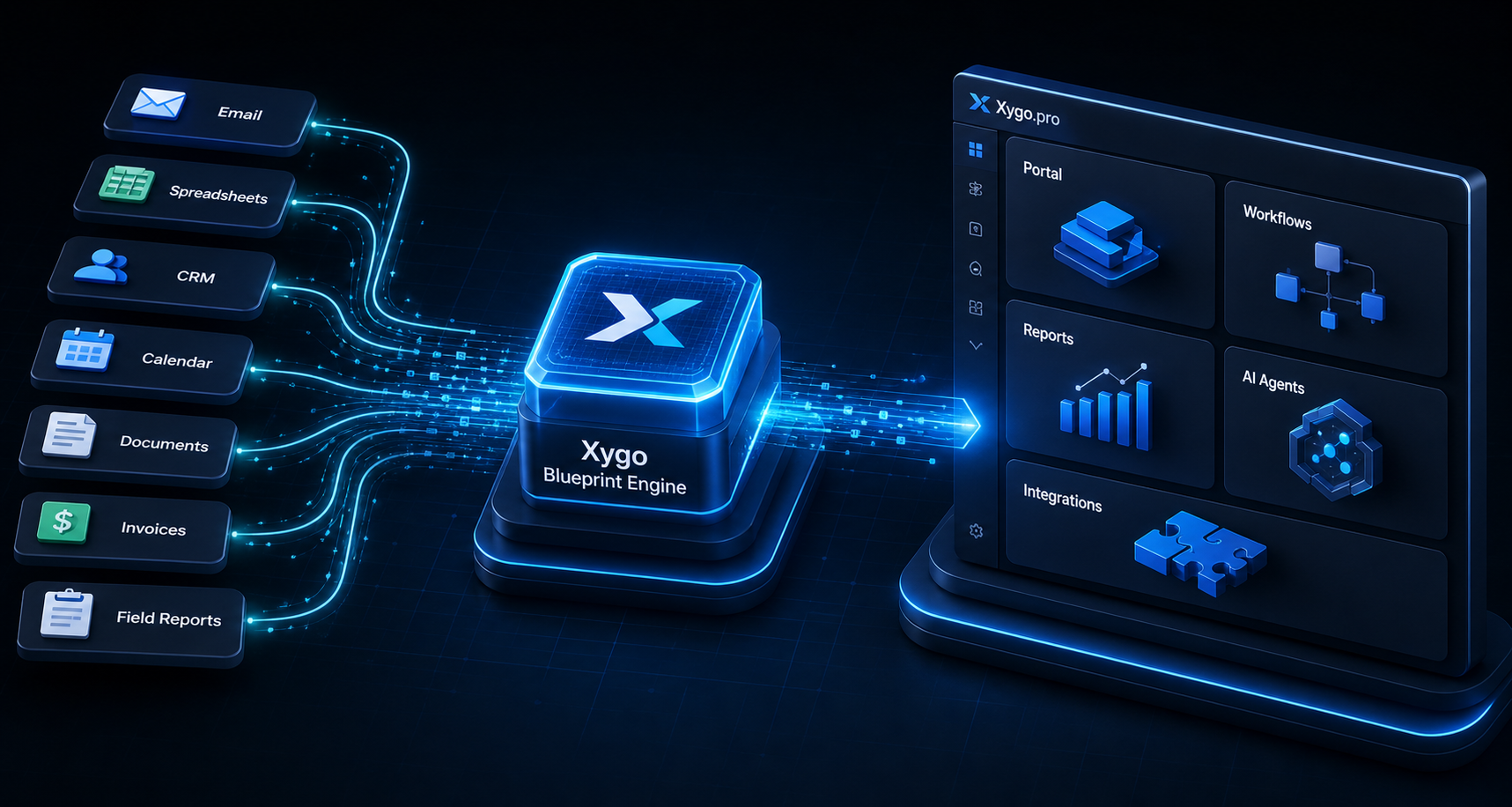
Xygo blueprints, generates, customizes, and deploys AI-powered operating systems that bring your workflows, teams, documents, customers, and data into one branded platform.
The Problem
Most businesses do not have an operating system. They have disconnected tools.
Email chains, shared calendars, file folders, paper forms, generic CRMs, and repeated data entry become the real operating model.
Customers lack status updates, managers cannot see the full operation, and owners stay trapped in routine coordination.
Permits, insurance files, reports, invoices, and approvals sit in different places until someone has to chase them.
Buying another subscription often adds another place to manage instead of solving how the business actually runs.
The Xygo Model
Xygo first understands the business, then builds the operating layer around it.
A customer explains how the company operates. Xygo turns that information into a blueprint, assembles the right modules, and delivers a branded system the business can actually use.
Roles, handoffs, workflows, documents, reports, approval points, and customer visibility are mapped before anything is built.
Portals, dashboards, scheduling, document workflows, reporting, integrations, and AI agents are assembled around the blueprint.
Xygo delivers the environment instead of handing customers another blank tool they must configure themselves.
How It Works
From scattered operations to one custom business operating system.
Study the current operation, tools, team structure, customer journey, and recurring bottlenecks.
Translate the business into data objects, workflows, roles, approvals, and reporting needs.
Assemble reusable modules and customize them for the exact operating model.
Deploy the branded workspace, train the team, and prepare the system for real operations.
Competitive Wedge
Xygo is not a template marketplace, no-code builder, agency, or chatbot wrapper.
The company sits between consulting, software generation, AI workflow design, and implementation.
- Blueprint-first system design before software decisions.
- Reusable modules customized to the client's operation.
- Branded portals and dashboards instead of generic vendor screens.
- AI agents tied to documents, approvals, reports, and follow-ups.
- Implementation delivered for the customer, not delegated to them.
Module Library
Common building blocks for operationally complex SMBs.
Project status, messages, files, approvals, invoices, and customer visibility.
Pipeline, workload, task status, escalations, and management reporting.
Booking, dispatch, reminders, assignment, and field coordination.
Contracts, permits, insurance, reports, forms, and review trails.
Checklists, expiration tracking, evidence, approvals, and correction requests.
Field notes, photo packages, executive summaries, and client-ready outputs.
Email, calendars, CRM, accounting, storage, payments, and industry tools.
Reception, coordination, document review, report drafting, and follow-up assistance.
Starting Markets
Xygo begins where operations are document-heavy, field-heavy, and hard to standardize.
Field reports, subcontractor compliance, permits, scheduling, files, invoices, and client updates.
Lead intake, dispatch, job notes, customer communication, payments, and follow-up.
Site visits, documentation, report drafting, approvals, project records, and compliance history.
Example
Contractor operating system
A roofing contractor can move from scattered leads, texts, photos, folders, and invoices into a branded operating system for intake, scheduling, field reporting, client approvals, and follow-up.
- Lead intake and estimate scheduling
- Field photo reports and technician notes
- Customer portal with project status
- Invoice tracking and AI follow-up
- Insurance, permit, and compliance document review
Xygo vs. Traditional SaaS
The customer should not reshape the business around a vendor's fixed workflow.
Gives the customer a fixed product, configuration settings, and a support center. The business adapts to the software.
Studies how the business works and creates the operating system around its workflows, documents, roles, and customer experience.
Next Step
See what Xygo would build for your operation.
Request a demonstration or business systems assessment. The current demo uses Synthetic Data in a Non-production environment with Human Oversight.